“Eat less to lose fat” is one of the most common pieces of advice out there — and also one of the most misunderstood. Many people hear it and immediately picture tiny portions, constant hunger, and giving up foods they enjoy.
But here’s the truth: eating less doesn’t necessarily mean eating less food — it means eating fewer calories. That distinction changes everything.
Once you understand this, fat loss becomes far more manageable and far less miserable.
Eating Less vs. Eating Fewer Calories
Let’s clear this up first.
-
Eating less food = smaller portions, low volume
-
Eating fewer calories = less energy intake overall
These are not the same thing.
You can eat a large amount of food and still lose fat — as long as the total calorie intake stays lower than what your body uses.
On the flip side, you can eat very small portions of calorie-dense foods and still struggle to lose fat.
Why Volume Alone Doesn’t Determine Fat Loss
Your body doesn’t measure meals by plate size or food weight. It responds to energy intake over time.
This means:
-
Calorie-dense foods add up quickly
-
Low-calorie foods allow larger portions
-
Hunger is influenced by volume, fiber, and protein — not just calories
That’s why two meals that look very different can contain a similar number of calories.
A Simple Example That Changes Perspective
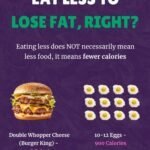
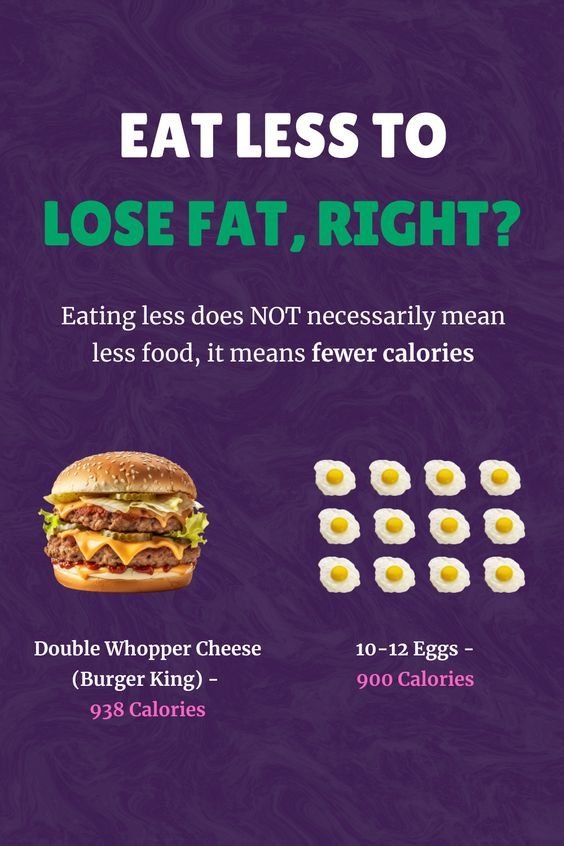
A single fast-food meal can contain close to the same calorie amount as a large plate of whole foods.
One option may look big and satisfying.
The other may look small but calorie-heavy.
Fat loss depends on the calorie total, not how “small” the meal looks.
Why “Eating Less” Often Backfires
When people interpret “eat less” as strict restriction, several problems tend to follow:
-
Constant hunger
-
Low energy
-
Cravings and binge cycles
-
Difficulty sticking to the plan
This isn’t a willpower issue — it’s a strategy problem.
When meals lack volume, fiber, and protein, your body pushes back hard.
The Smarter Way to Eat Less (Without Feeling Deprived)
The goal is not to eat tiny meals — it’s to eat smarter meals.
That usually means:
-
Choosing foods that give more volume per calorie
-
Prioritizing protein to stay full
-
Using vegetables and fruits to bulk up meals
-
Being mindful of calorie-dense extras
This approach lets you eat satisfying portions while still maintaining a calorie deficit.
Why Some Foods Feel “Fattening” (But Aren’t the Enemy)
Foods like burgers, cheese, oils, and sweets aren’t bad — they’re just very calorie-dense.
Small portions can:
-
Add hundreds of calories
-
Leave you less full
-
Make calorie control harder
That doesn’t mean you must eliminate them. It simply means portion awareness matters more with these foods.
Fat Loss Is About Patterns, Not Single Meals
One meal doesn’t make or break progress.
Fat loss comes from:
-
Daily consistency
-
Weekly calorie balance
-
Sustainable habits
Focusing on long-term patterns is far more effective than obsessing over individual foods.
A Better Question to Ask Yourself
Instead of asking:
“Am I eating less food?”
Try asking:
“Am I eating foods that help me stay full on fewer calories?”
That mindset shift removes guilt and makes fat loss feel doable again.
Final Thoughts
Yes, you do need to eat less to lose fat — but “less” refers to calories, not plate size.
You don’t need to starve.
You don’t need tiny meals.
You don’t need extreme restriction.
You need awareness, balance, and meals that work with your hunger — not against it.
Save this for later or share it with someone who thinks fat loss means eating like a bird. And ask yourself: what’s one simple swap you can make to lower calories without shrinking your meals?